Guides
Bouldering Terms: 85 Climbing Words and Slang Explained
Learn 85 bouldering terms in plain English: holds, moves, grades, gym talk, gear and slang, with drawn diagrams and the official competition scoring.
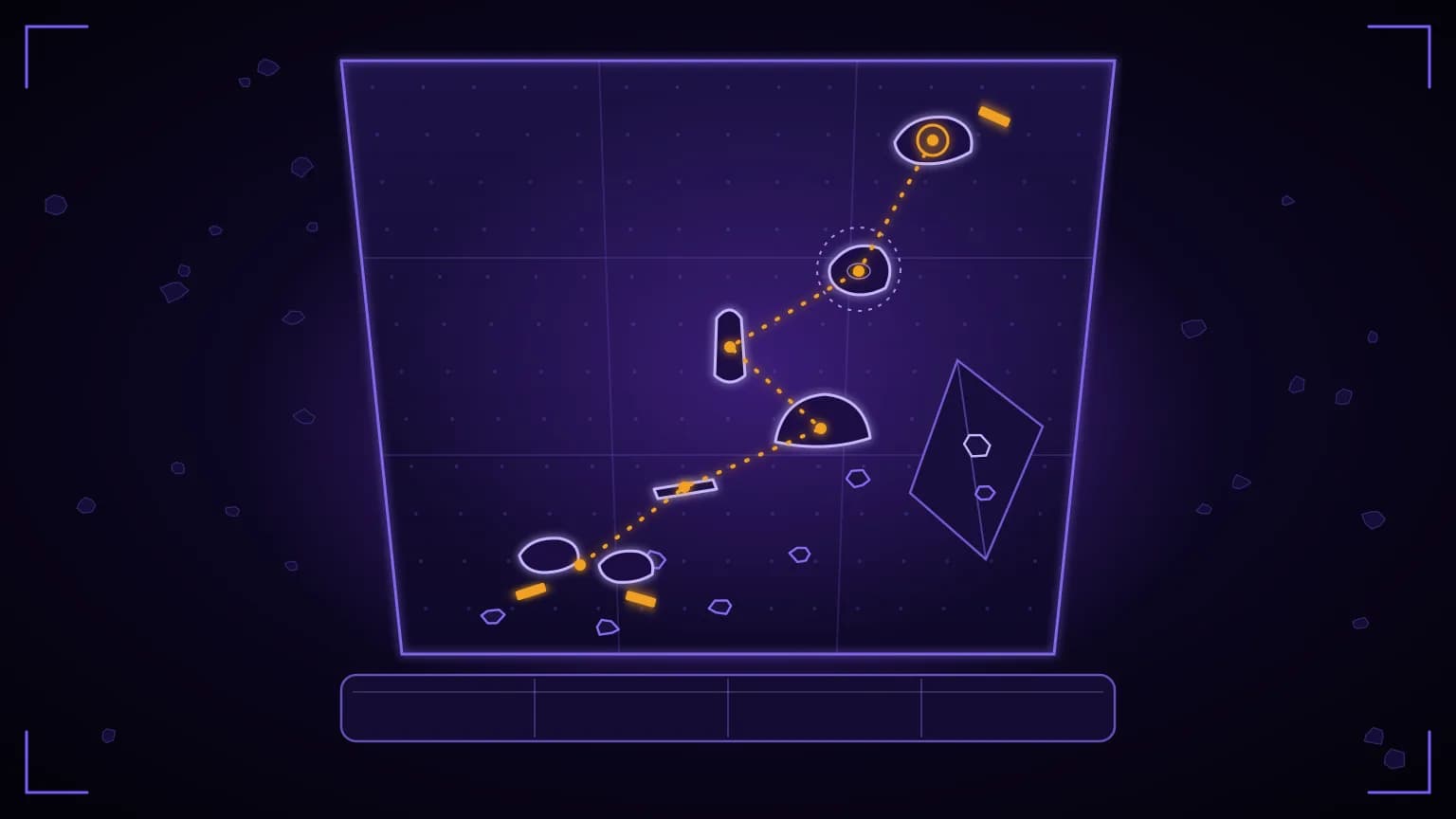
Bouldering terms fall into seven groups: the gym and the problem, holds, moves, grades and ascents, competition scoring, gear and slang. Learn these ten first and you can follow most conversations at the wall: problem, beta, send, flash, project, crux, jug, crimp, sloper and top out.
Below you get 85 terms, each in one or two plain sentences, with drawings of the holds and the footwork moves, the scoring rules World Climbing uses at competitions, and the safety facts behind the moves that injure climbers most. Use the tables as a lookup and the drawings to see what each word looks like on the wall.
Learn the words for the gym and the problem
A bouldering problem is a short climb, usually a few meters tall, that you climb without a rope above a padded floor. Gyms and outdoor areas share most of this vocabulary.
| Term | What it means |
|---|---|
| Problem | One bouldering climb, from its start holds to its finish. You climb a problem. Roped climbers climb routes. |
| Boulder | The rock you climb outdoors, and in competitions the word for one problem. |
| Circuit | A set of problems marked in one color, often grouped by difficulty, so you can climb your way through a band of grades. |
| Setter | The person who designs and bolts the problems in a gym. |
| Start holds | The marked holds you begin on, usually with a tag of tape beside them. Put both hands on them before you leave the ground. Some problems also mark starting footholds. |
| Sit start | A start from sitting on the mat, also written SDS for sit-down start. The first move pulls you off the floor. |
| Finish hold | The last hand hold, marked with tape or a "top" label. You finish when you hold it with both hands under control. |
| Top out | Finishing by climbing over the top of the boulder and standing on it. Many outdoor problems end this way, and some gyms build a top-out wall. |
| Match | Putting both hands on the same hold. Matching the finish hold ends most gym problems. |
| Downclimb | Climbing back down on big holds instead of jumping from the top. |
| Volume | A large hollow shape bolted to the wall, often with holds screwed onto it. You can stand or press on its surface. |
| Arete | An outside corner, the edge where two wall faces meet. You can grip and squeeze it. |
| Slab | A wall angled less than vertical. Your feet carry most of your weight and balance matters more than strength. |
| Overhang | A wall steeper than vertical, which leans over you. Your arms work harder and your feet try to swing off. |
| Spray wall | A steep wall covered in holds with no marked problems. You and your friends make up your own. |
| Fall zone | The padded area under a problem where a falling climber lands. Never sit or stand in it while someone climbs. |
Name the holds you grab
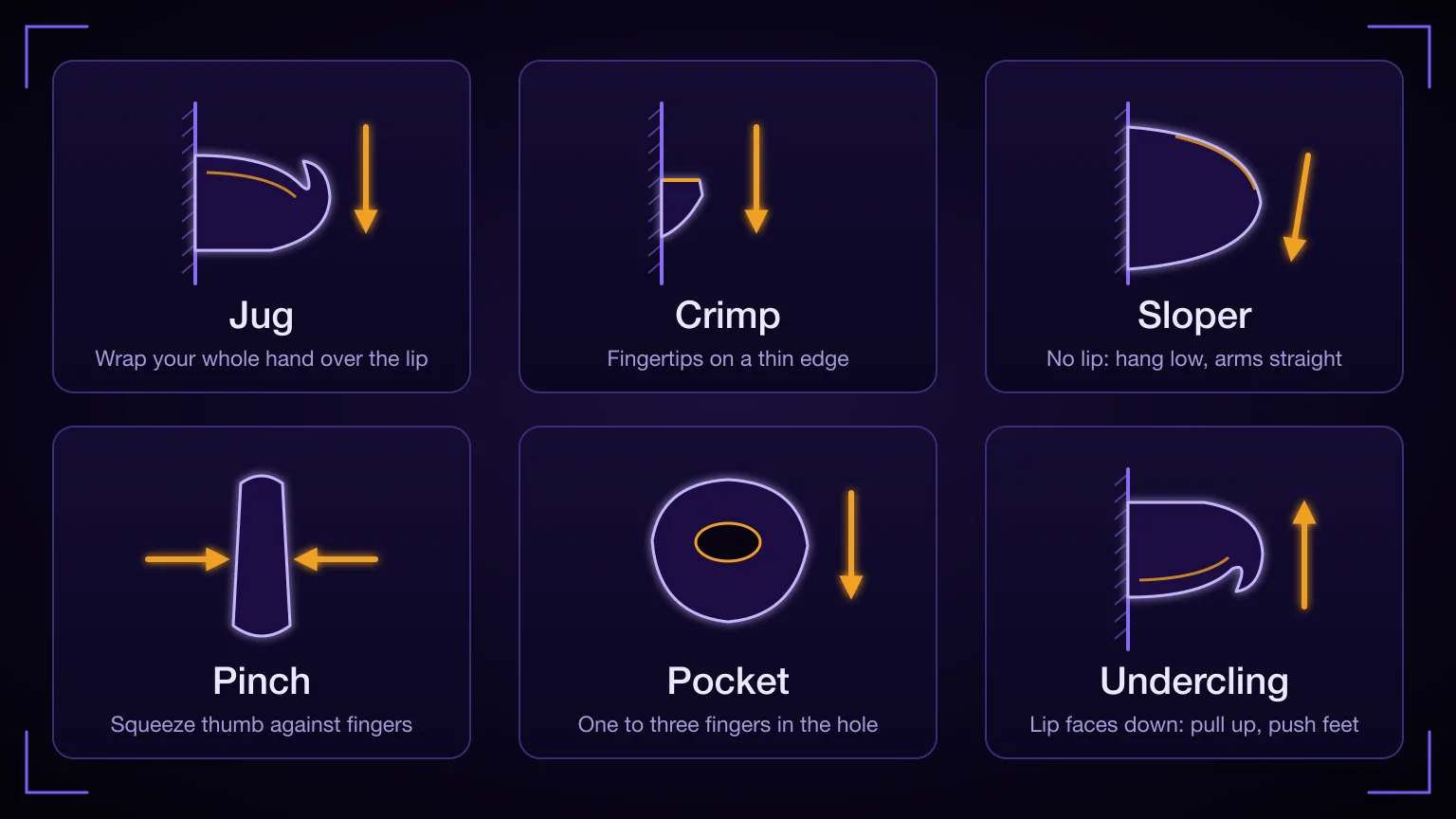
Every hold has a best direction to pull. Find that direction and a hold that felt impossible starts to feel usable.
| Term | What it means |
|---|---|
| Jug | A big, deep hold you can wrap your whole hand around. Also called a bucket. |
| Crimp | A small edge you hold with the tips of your fingers. You grip it in an open, half or full crimp. |
| Open hand | A grip with your fingers only slightly bent. It loads your finger pulleys the least. |
| Half crimp | Your middle finger joints bent to about 90 degrees with your thumb off the hold. Many finger training plans target this grip. |
| Full crimp | Your middle finger joints bent sharply, your fingertip joints bent backward and your thumb locked over your index finger. It feels strongest and loads your pulleys hardest. |
| Edge | A flat, square-cut hold, large or small. The same word covers a small foothold you stand on with the edge of your shoe. |
| Sloper | A rounded hold with no lip. Friction and body position keep you on it, so hang low beneath it with straight arms. |
| Pinch | A hold you squeeze between your thumb and fingers. |
| A hole you fit one, two or three fingers into. A one-finger pocket is a mono. | |
| Sidepull | A hold that faces sideways. You pull it toward your body while you lean away from it. |
| Gaston | A sidepull that faces away from you, which you push outward with your elbow raised, like prying open elevator doors. |
| Undercling | A hold that faces down. You pull up on it from below and push with your feet. |
How much do grips differ? Schweizer measured finger forces in four climbers and found that the crimp grip loaded the A2 pulley, the ring of tissue that holds your flexor tendons against the finger bone, at about three times the force at the fingertip, up to 116 N. The half crimp vs full crimp guide shows when to use each grip.
Learn the moves and body positions
Most moves fall into three families: how you reach, how you use your feet, and where you put your hips.
| Term | What it means |
|---|---|
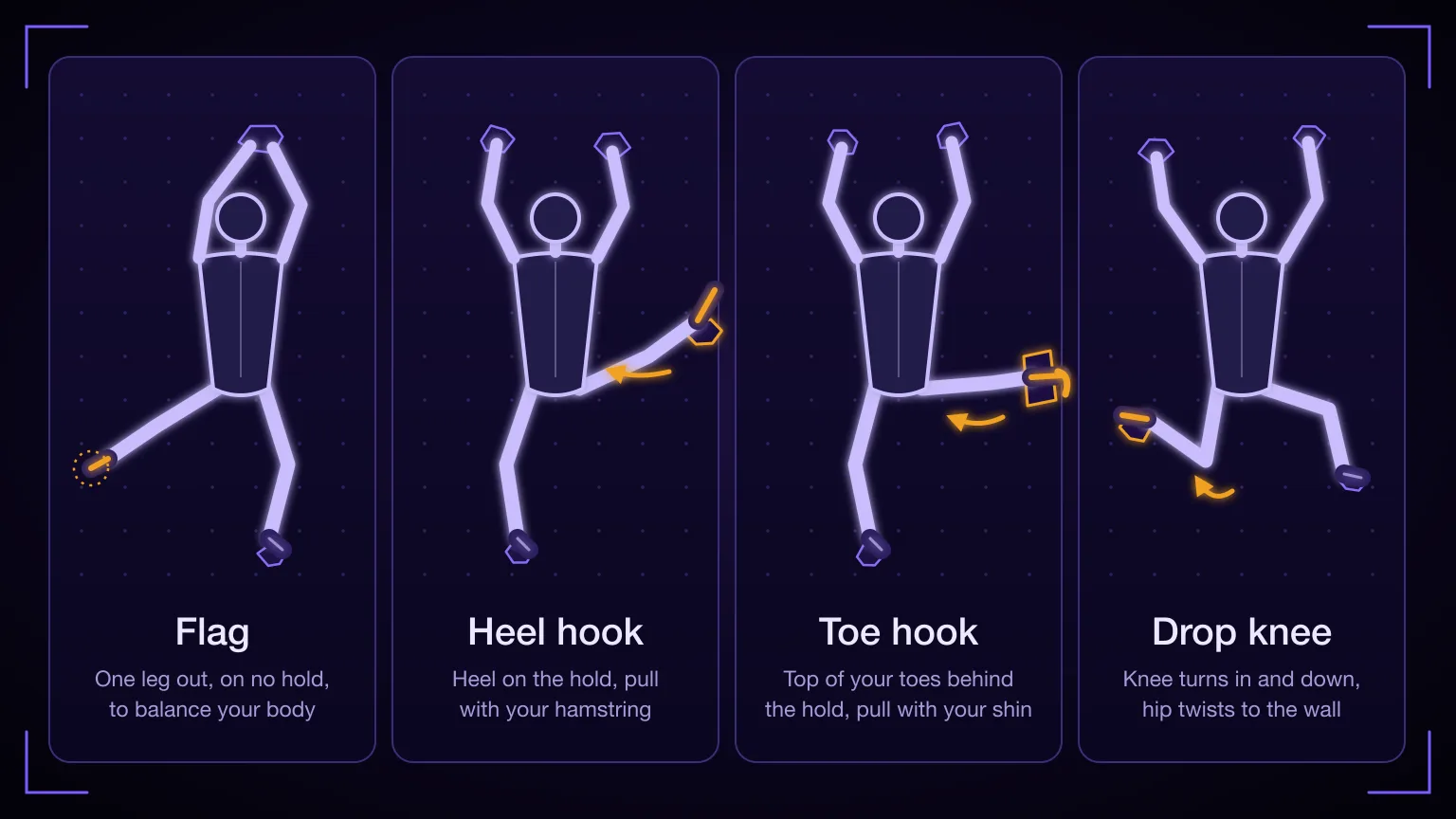
| Flag | Holding one leg out against the wall, on no hold, to balance your body. It stops you swinging away from the wall. See flagging in climbing. |
| Heel hook | Your heel on a hold, pulling with your hamstring as if it were a third hand. Learn it step by step in the heel hook guide. |
| Toe hook | The top of your toes hooked under or behind a hold, pulling with your shin. It keeps your body on steep walls. |
| Drop knee | One knee turned in and down, foot on a hold, so your hip twists into the wall and you reach higher. The drop knee guide shows the setup. |
| Smear | Pressing the sole of your shoe flat on the wall where there is no hold, trusting friction. |
| Edging | Standing on a small hold with the inside or outside edge of your shoe. |
| High step | Placing a foot high, near your hip, then standing up on it. |
| Layback | Pulling sideways on a vertical edge while your feet push the other way. Also spelled lieback. |
| Compression | Squeezing two holds or features toward each other with your hands, feet or both. |
| Mantle | Pushing down on a ledge or the top until your arm locks straight, then stepping a foot up beside your hand, like climbing out of a pool. |
| Deadpoint | A dynamic reach where you grab the next hold at the top of your body's swing, where you feel weightless, with at least one foot still on. |
| Dyno | A jump to a hold where your feet leave the wall, and often both hands too. |
| Cross-through | Reaching past your other hand to the next hold. |
| Cut loose | Your feet swinging off the wall on an overhang, leaving you hanging from your hands. |
| Campus | Climbing with your hands only, feet off. Also the name of the board built for this training. |
| Barn door | Swinging off the wall like a door on its hinges when your hands and feet sit on one vertical line. A flag or a drop knee fixes it. |
Read grades and ascents
Grades tell you how hard a problem feels to the climbers who set and repeat it. Two scales dominate bouldering.
| Term | What it means |
|---|---|
| Grade | The difficulty rating of a problem. It reflects consensus and drifts from gym to gym. |
| V-scale | The North American scale. It starts at VB or V0 and climbs one number at a time, V1, V2, V3 and up. |
| Font scale | The European scale, named for Fontainebleau in France. It pairs a number with a letter and an optional plus, such as 6A, 6A+ and 6B. Convert between the two with the V-scale and Font grade guide. |
| Send | Climbing a problem from start to finish without falling. As a noun, "a send." |
| Flash | Sending a problem on your first attempt, even if you watched someone else climb it first. |
| Onsight | Sending on your first try with no information at all. Climbers use it mostly for roped routes, since you see the whole boulder from the ground. |
| Redpoint | A roped-climbing word for sending a route after practice. In bouldering you just say you sent it. The flash vs redpoint guide covers both words. |
| Project | A problem you work on over several sessions. As a verb, "I'm projecting it." |
| Beta | The sequence of moves for a problem: which hand goes where, which foot when. |
| Beta spray | Beta you hear without asking for it. Ask before you share it. |
| Attempt | One go at a problem, from leaving the ground to falling or finishing. Climbers also call it a burn. |
| Crux | The hardest move or section of a problem. |
| Sandbag | A problem harder than its grade, or the act of grading it too low. |
| Soft | A problem easier than its grade. |
| Dab | Touching the ground, the pad or your spotter during a problem. A dab means the attempt does not count. |
How long does one attempt last? White and Olsen filmed elite climbers at a national competition and timed attempts at 28.9 seconds on average, with 114 seconds of rest between them and about 3 attempts per problem. Your attempts are short and your rests are long, which is also why a session burns fewer calories than you might guess. Check your own numbers with the bouldering calories calculator.
Good beta saves energy as well as attempts. Bertuzzi and colleagues found that recreational climbers spent 60.1 kJ on an easy route that cost elite climbers 40.3 kJ, about 50% more energy for the same moves.
Score a competition boulder
Competition bouldering uses its own short list of words, defined in the World Climbing competition rules (version 3, January 2026).
| Term | What it means in the rules |
|---|---|
| Starting position | Holds marked for both hands and both feet. You must reach a stable position on all of them before you use any other hold, or the start counts as a false start. |
| Attempt | It starts when you leave the ground. |
| Zone | A marked hold partway up the boulder, in a different color from the start holds. You earn it when you control it with your hands and make a move from it. |
| Top | You match the finish hold with both hands in a stable, clearly controlled position, or you stand on top of the boulder. |
| Points | Since 2025, a top scores 25 points and the zone 10 points, minus 0.1 points for every unsuccessful attempt. The IFSC World Cup adopted this format in 2025, close to the scoring of the Paris 2024 Olympics. |
Here is how the points play out on two boulders.
| Climber | Boulder 1 | Boulder 2 | Total |
|---|---|---|---|
| A | Flash: 25.0 | Top on attempt 3: 24.8 | 49.8 |
| B | Top on attempt 2: 24.9 | Top on attempt 2: 24.9 | 49.8 |
| C | Flash: 25.0 | No top | 25.0 plus any zone points |
Climbers A and B tie, even though A flashed one boulder. Every failed attempt costs the same 0.1 points, whichever boulder it falls on.
Know the gear
Bouldering needs little gear, but each piece has its own word.
| Term | What it means |
|---|---|
| Climbing shoes | Tight shoes with sticky rubber soles. Climbers call a shoe with a toe-down curve downturned, and a shoe whose toe points toward the big toe asymmetric. |
| Chalk | Magnesium carbonate powder that dries your hands. Amca and colleagues tested 11 experienced climbers on two rock types and found chalk raised the friction between fingers and holds. |
| Liquid chalk | Chalk mixed with alcohol that you rub on and let dry, often as a base layer under powder. |
| Brush | A stiff brush for cleaning chalk and rubber off holds. A clean hold grips better. |
| Crash pad | A folding foam mat you carry outdoors and place under a problem. |
| Spotter | A partner who guides your fall toward the pad and protects your head and back. A spotter never tries to catch you. |
| Highball | A tall boulder where a fall carries real injury risk even with pads. |
| Hangboard | A board of edges and pockets you hang from to train finger strength. Also called a fingerboard. |
| Campus board | An overhanging board of wooden rungs you climb with your hands only. It suits experienced climbers. |
| MoonBoard | A training board built to one of Moon Climbing's fixed hold setups, at 25 or 40 degrees. You browse and set its problems in the MoonBoard app. |
| Kilter Board | A board with LED-lit holds. You pick a climb in the app and the holds light up on the board. |
Decode the slang
Climbers love slang. Most of it is friendly.
| Term | What it means |
|---|---|
| Crusher | A very strong climber. |
| Gumby | A new climber, usually said with affection. |
| Pumped | Your forearms feel tight and swollen and your grip fades. |
| Flapper | A torn flap of skin on your finger or palm. |
| Gobies | Scrapes and cuts on the backs of your hands from rough rock or holds. |
| Pop | A finger pulley injury, named for the sound some climbers hear when it happens. |
| Sketchy | Insecure or likely to go wrong, like a move above a bad landing. |
| Thank-god hold | A big, good hold after a hard section. |
| Elvis leg | A leg that shakes from fatigue or fear. Also called sewing-machine leg. |
| Allez | French for "go," shouted to cheer a climber on. |
Avoid the mistakes beginners make with these words
| Mistake | What happens | Fix |
|---|---|---|
| You say "route" for a boulder | Climbers understand you, but the beta talk gets mixed up with roped climbing. | Say problem indoors, boulder or problem outdoors. |
| You treat every small hold as a full crimp | You load your finger pulleys at their hardest on every move. | Grip small edges in a half crimp or open hand, and save the full crimp for the hold that truly needs it. |
| You call a send after many tries a flash | Your partners think you climbed it first go. | Flash means first attempt. After that, you sent it. |
| You jump from the top every time | You land from the full height of the wall. | Downclimb on big holds, then drop from a lower point. |
| You give beta nobody asked for | You take away the puzzle another climber wanted to solve. | Ask "want beta?" first. |
| You read a grade as a fixed number | A V4 at one gym feels like a V3 or V5 at another. | Compare problems within your own gym and log how each one felt. |
Stay safe on the moves that hurt climbers
Three groups of terms on this page tie directly to the most common bouldering injuries.
- Falls and landings. Jemmett and colleagues reviewed 176 patients treated for bouldering injuries at a UK major trauma center over ten years: the average reported fall height was 2.9 m, 62% of injuries hit the lower limb and ankle fractures were the most common diagnosis. In a French survey of 245 injured boulderers, Beurienne and colleagues found that 85% of the falls were unplanned and 74% ended in a feet-first landing. Downclimb when you can, land on both feet with bent knees, and keep the fall zone clear.
- Crimps and pulleys. Miro and colleagues describe finger flexor pulley injuries as the most common overuse injury in climbers, with the crimp grip as the mechanism. Warm up on big holds first, and stop if you feel sharp finger pain or hear a pop.
- Heel hooks and hamstrings. Ehiogu and colleagues note that acute hamstring injuries in climbers often come from the heel hook. Warm up your legs before steep heel-hook problems, and ease off when the back of your thigh feels sharp or tight.
See a sports medicine physician or a physiotherapist who treats climbers if you heard a pop in a finger, feel pain that lasts beyond a few days, or cannot bear weight after a fall. Rest the injured area until a professional clears you.
Try one new move this week
Get quick answers
What does beta mean in bouldering?
Beta is the sequence of moves for a problem: which holds you use, in what order, and where your feet go. "Beta spray" means beta you hear without asking for it.
What is the difference between a flash and a send?
A send is any clean ascent from start to finish. A flash is a send on your first attempt, even if you watched someone climb it first.
What does crux mean in climbing?
The crux is the hardest move or section of a problem. On many boulders, the crux comes right off the start.
What is a sit start in bouldering?
A sit start begins with you sitting on the mat, hands on the start holds. It adds hard moves at the bottom, and guidebooks write it as SDS.
What does it mean when climbers say a problem is sandbagged?
A sandbagged problem feels harder than its grade. The opposite is soft, a problem that feels easier than its grade.
Check the sources
- World Climbing, competition rules, version 3, January 2026
- World Climbing, new rule changes for the 2025 World Cup series
- Schweizer, biomechanical properties of the crimp grip position in rock climbers, PubMed
- Miro and colleagues, finger flexor pulley injuries in rock climbers, PubMed
- Amca and colleagues, the effect of chalk on finger friction in rock climbing, PubMed
- White and Olsen, a time motion analysis of competitive bouldering, PubMed
- Bertuzzi and colleagues, energy system contributions in indoor rock climbing, PubMed
- Jemmett and colleagues, bouldering-related trauma at a UK major trauma center, PubMed
- Beurienne and colleagues, fall scenarios behind bouldering injuries, PMC
- Ehiogu and colleagues, acute hamstring muscle tears in climbers, PubMed
- Moon Climbing, choose your MoonBoard
- Kilter, app support and how to light a climb